An older person who cannot easily get to an optician can still have a full, professional eye examination at home. An optometrist brings portable equipment to the person's own front room, tests their sight, checks the health of their eyes and issues a written prescription if one is needed. If your parent, grandparent or neighbour is 60 or over and cannot leave the house alone because of illness or disability, the visit may well be paid for by the NHS. At iCare Vision Specialists in Coventry we offer home eye examinations for exactly this situation.
This guide explains what a home visit involves, who is entitled to a funded one, how to prepare someone with dementia or limited mobility, and which symptoms should never wait for a routine appointment.
TL;DR
- A home sight test is a real clinical examination, not a screening app: the optometrist checks vision, the prescription and the inside and outside of the eyes.
- Being 60 or over qualifies someone for a free NHS sight test, but a funded home visit also requires that they cannot leave home unaccompanied because of physical or mental illness or disability.
- A relative or carer should ask for the visit and, where possible, be present on the day.
- Sudden sight loss, severe eye pain, flashing lights or a dark shadow across vision need urgent medical help, not a booked home visit.
- In Coventry, you can ask us about a home eye examination for a parent or relative.
Table of Contents
- What a home eye test actually is
- Who can have a home eye test
- Is a home eye test free on the NHS?
- How to arrange a home visit
- Preparing an older person for the visit
- Why regular tests matter in later life
- When not to wait for a home visit
- Home visit or practice visit: which is right?
- Home eye examinations with iCare in Coventry
- FAQ
- Sources
What a home eye test actually is
A home eye test, sometimes called a domiciliary sight test, is the same examination someone would have in a practice, carried out where they live. The Association of Optometrists says optometrists who provide this service carry equipment that allows an accurate sight test in your home, and can adapt the test for people with complex needs or who find it hard to communicate or understand, for example after a stroke or with dementia or learning disabilities.
It is worth separating this from the online "eyesight checks" and printable charts you may find. The American Academy of Ophthalmology is clear that a home vision test is no substitute for an exam by an eye care provider. A chart on the kitchen wall can show that something has changed. It cannot tell you why, and it cannot look inside the eye.
What the optometrist does during the visit
According to the Association of Optometrists, a domiciliary sight test typically includes:
- Checking close-up and distance vision using charts of symbols or letters.
- Trying different lenses to work out whether glasses, or a new prescription, are needed.
- Examining the inside and outside of the eyes to check they are healthy.
- Where appropriate, using eye drops, checking peripheral (side) vision or offering an eye-pressure test.
- Talking through the results and providing a written statement, including any new prescription.
The same source notes that sight tests can sometimes reveal signs of wider health conditions such as diabetes, high cholesterol and high blood pressure. For an older person who sees few professionals, that matters.
If drops are used, the Scottish NHS guide points out that you should not drive straight afterwards. The same guide says an examination takes about 30 minutes but can need longer, and that anyone can refuse any part of it. For a frail or anxious person, that last point is reassuring: nothing has to be done that they are not comfortable with.
Who can have a home eye test
Home visits are not for anyone who would simply prefer not to travel. The College of Optometrists says a domiciliary examination should only be provided for patients who cannot attend a practice because of physical or mental disability. That includes people who are frail or ill, who have challenging behaviour, or who become distressed when taken out of familiar surroundings. It should be done at the request and with the consent of the patient or a relative or primary carer, and only if it is in the patient's best interests.
In practice, that covers people who:
- are housebound or bedbound;
- need another person's help to leave the house safely;
- live in a residential or care home;
- have dementia, a previous stroke or a condition that makes travelling or waiting rooms distressing.
RNIB says that anyone unable to leave home because of physical or mental illness is entitled to an eye test at home, and that this should happen at least every two years, or more often if an optometrist or doctor advises.
Is a home eye test free on the NHS?
This is the question families get wrong most often, so it is worth being precise. Age alone does not make a home visit free. There are two separate tests, and both have to be met.
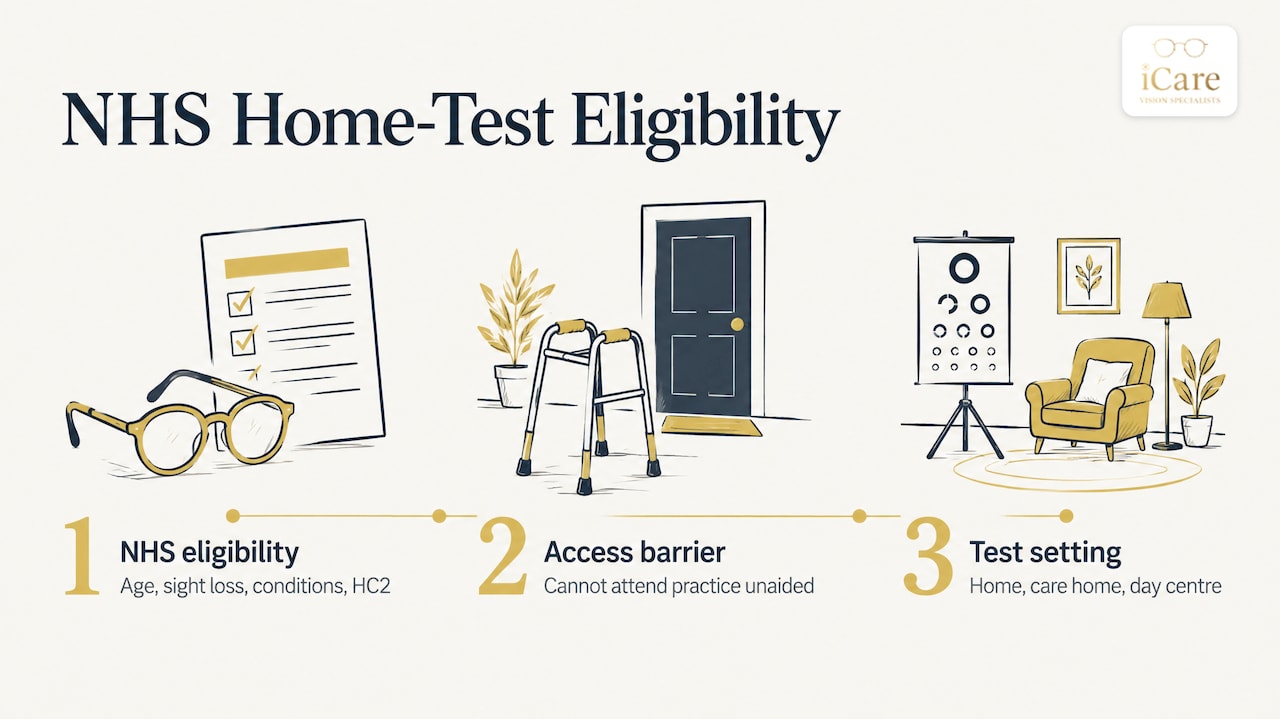
Step one: is the person eligible for an NHS sight test? The NHS lists the groups, including people aged 60 or over, under 16, or 16 to 18 in full-time education. It also includes people registered partially sighted or blind, people with diabetes or glaucoma, people aged 40 or over with a close relative who has glaucoma, and people who qualify through the NHS low income scheme (HC2 certificate).
Step two: can they get to a practice? The same NHS page says that eligible people may qualify for a mobile test at home, or in a residential or care home, if they cannot leave unaccompanied because of illness or disability. A day-centre test is possible if illness or disability prevents a test in a practice, or if the person has difficulty communicating their health needs unaided.
So a 78-year-old who walks to the shops every week is eligible for a free NHS sight test, but at a practice. A 78-year-old with advanced Parkinson's who cannot leave the house without two people helping is eligible for a free test at home.
If the person is not in an NHS-funded group, or the visit does not meet the home-visit criteria, a private examination is the route. Rules differ between nations: RNIB explains that in Scotland all eye examinations are free, while in England, Wales and Northern Ireland a home test is free if you are eligible for a free NHS eye test.
Recall dates and earlier tests
NHS-funded patients are given a recall date, usually two years ahead. RNIB notes that testing before that date may incur a private fee, unless you or the person's doctor is worried about a change in vision. In that case the optometrist can see them sooner on the NHS. The Association of Optometrists adds that in England an NHS sight test is only carried out when it is clinically necessary.
You or a relative will normally need to make the request. The Association of Optometrists says the person, a relative or the main carer must ask for the domiciliary test.
How to arrange a home visit
RNIB suggests starting by calling the optometrist you already use, because not every practice offers visits. If you are in Coventry, you can contact us directly about a home eye examination, and we will talk you through what is needed.
Have these details to hand when you call:
- The person's name, address and a contact number, plus who will be at home on the day.
- Why they cannot attend a practice. A short, honest description is enough: mobility, frailty, dementia, distress outside the home.
- Whether they are NHS-eligible, and on what basis (age 60 or over, diabetes, glaucoma, HC2).
- Any known eye conditions or recent changes in vision.
- Whether they live in their own home or a care setting, since this affects who needs to be present.
- Any communication needs, such as hearing loss, difficulty speaking or confusion at certain times of day.
Hearing and sight problems often go together in later life. If hearing is also a concern, it is worth mentioning when you book, as we also offer hearing care.
Preparing an older person for the visit
A calm visit gives the optometrist better results. The College of Optometrists advises that, in a domiciliary setting, a relative or carer should be present where possible, that communication difficulties caused by physical, sensory or mental disabilities should be accommodated, and that suitable portable equipment should be used.
What to put out beforehand
RNIB's list for any eye examination applies at home too. Gather:
- every pair of glasses the person currently uses, including reading and distance pairs;
- a list of medications and eye treatments, including drops;
- any letters from the hospital eye clinic or GP about eye problems;
- a note of how they use their eyes day to day, such as how close they hold a book or how far they sit from the television;
- a short list of your own questions.
RNIB also advises telling the optometrist in advance if the person has diabetes or additional needs, including learning disabilities, autism or physical disabilities.
Practical tips for the day
- Choose their best time of day. If someone is sharper in the morning, book then. Research on dementia-friendly eye care emphasises flexible scheduling and environmental changes as part of adapting an examination.
- Good lighting, a comfortable chair and a quiet room. Switch off the television and move pets out of the way.
- Explain what is happening in simple words before the optometrist arrives, but avoid building it up into something stressful.
- Stay close. Familiar faces help a person who becomes unsettled with strangers.
- Do not insist on every test. If one part is too much, the optometrist can do what is possible. The College of Optometrists guidance says to carry out whichever tests can be done for both sight and eye health.
If the person has dementia
A person with dementia can still have a meaningful eye test, because it does not depend on reading letters aloud. Optometrists can use other ways to judge the prescription and examine the eyes. A 2026 paper in the Australian Journal of Optometry describes a dementia-friendly approach as adjustments before, during and after the appointment. It also says that testing of contrast sensitivity, binocular vision and visual fields matters, because problems here are common even when standard acuity looks normal, and they are linked with falls and loss of independence.
That is a good reason not to wait for a person to say they cannot see. Many older adults will not report a problem, and some will not recognise one.
Why regular tests matter in later life
The Association of Optometrists advises a sight test every two years, or more often if the optometrist recommends it. Scotland's NHS guide states that people aged 60 and over are entitled to a routine NHS examination every year, as are people with diabetes. In England the recall interval is set by the optometrist according to clinical need, so ask what is right for your relative.
Eye examinations can detect conditions such as cataracts, and general health problems such as diabetes or high blood pressure. For the older person you care for, a current prescription can mean steadier walking, easier reading of medication labels and a better chance of recognising faces.
When not to wait for a home visit
A booked home test is for routine checks and gradual changes. Some symptoms are different. The NHS says to ask for an urgent GP appointment or contact NHS 111 if someone has blurred or double vision, flashing lights or shapes, a dark shadow moving across their vision, pain in one or both eyes, or a red and painful eye.
Go to A&E or call 999 if they suddenly cannot see from one or both eyes, or suddenly have severe eye pain. The NHS advises not to drive yourself to A&E: ask someone else to drive, or call 999 for an ambulance.
For eye problems that need prompt attention but are not sudden sight loss, such as a red irritated eye, an infection or a foreign body, we provide emergency eye care in Coventry. Call before you travel, so that the right person can see your relative.
Home visit or practice visit: which is right?
| Situation | Usual best route |
|---|---|
| Walks independently, uses transport, copes with waiting rooms | Practice sight test |
| Needs help from another person to leave home, but manages a short trip | Practice visit with a relative, or ask about a home visit if travel is a struggle |
| Cannot leave home unaccompanied due to illness or disability | Home eye examination |
| Lives in a residential or care home | Home eye examination at the home |
| Sudden loss of sight or severe eye pain | Emergency help: A&E or 999 |
| Painful red eye, suspected infection or something in the eye | Urgent eye care, see above |
If you are unsure which row fits, describe the situation to us. We will tell you what is realistic.
Home eye examinations with iCare in Coventry
Our approach combines primary medical eye care and advanced diagnostic equipment with optometrists who take time to understand each person's eye health needs. That matters most with an older patient, where the history, the medication and the worries of the family are part of the examination. We offer home eye examinations for people in Coventry who cannot easily visit us, and the full range of our eye care services is available to the whole family, including diabetic eye care and glaucoma management.
If your relative needs new glasses after the test, our team can help with prescription glasses from designer and in-house ranges. To ask about a visit, start from our home eye tests page.
FAQ
Can an eye test be done at home?
Yes. An optometrist can carry out a full sight test at a person's home using portable equipment, including checking vision, working out the prescription and examining the inside and outside of the eyes. The test can be adapted for people with dementia or communication difficulties. Home visits are intended for people who cannot attend a practice because of illness or disability.
Who is eligible for a free home eye test?
The person must qualify for an NHS sight test, for example by being 60 or over, having diabetes or glaucoma, or being registered partially sighted. They must also be unable to leave home unaccompanied because of physical or mental illness or disability. In Scotland all eye examinations are free.
Can an online eyesight check replace an optician's examination?
No. An online or printed chart can suggest that vision has changed, but it cannot check eye health or give a prescription. A proper sight test looks inside the eyes and can pick up conditions before they cause symptoms.
What should I have ready for the visit?
Current glasses, a list of medicines and eye drops, any letters about previous eye treatment, and notes on how the person uses their eyes day to day. Tell the optometrist beforehand about diabetes, dementia or any other additional needs.
Sources
- Domiciliary eye care, Association of Optometrists
- Home Vision Tests for Children and Adults, American Academy of Ophthalmology
- Your guide to free NHS eye examinations in Scotland
- The domiciliary eye examination, College of Optometrists
- Before your eye examination, RNIB
- Having an eye examination at home, RNIB
- Free NHS eye tests and optical vouchers, NHS
- NHS funding in England, Association of Optometrists
- Vision, hearing, and dementia in older adults, Australian Journal of Optometry
- Eye care, nidirect
- Vision loss, NHS